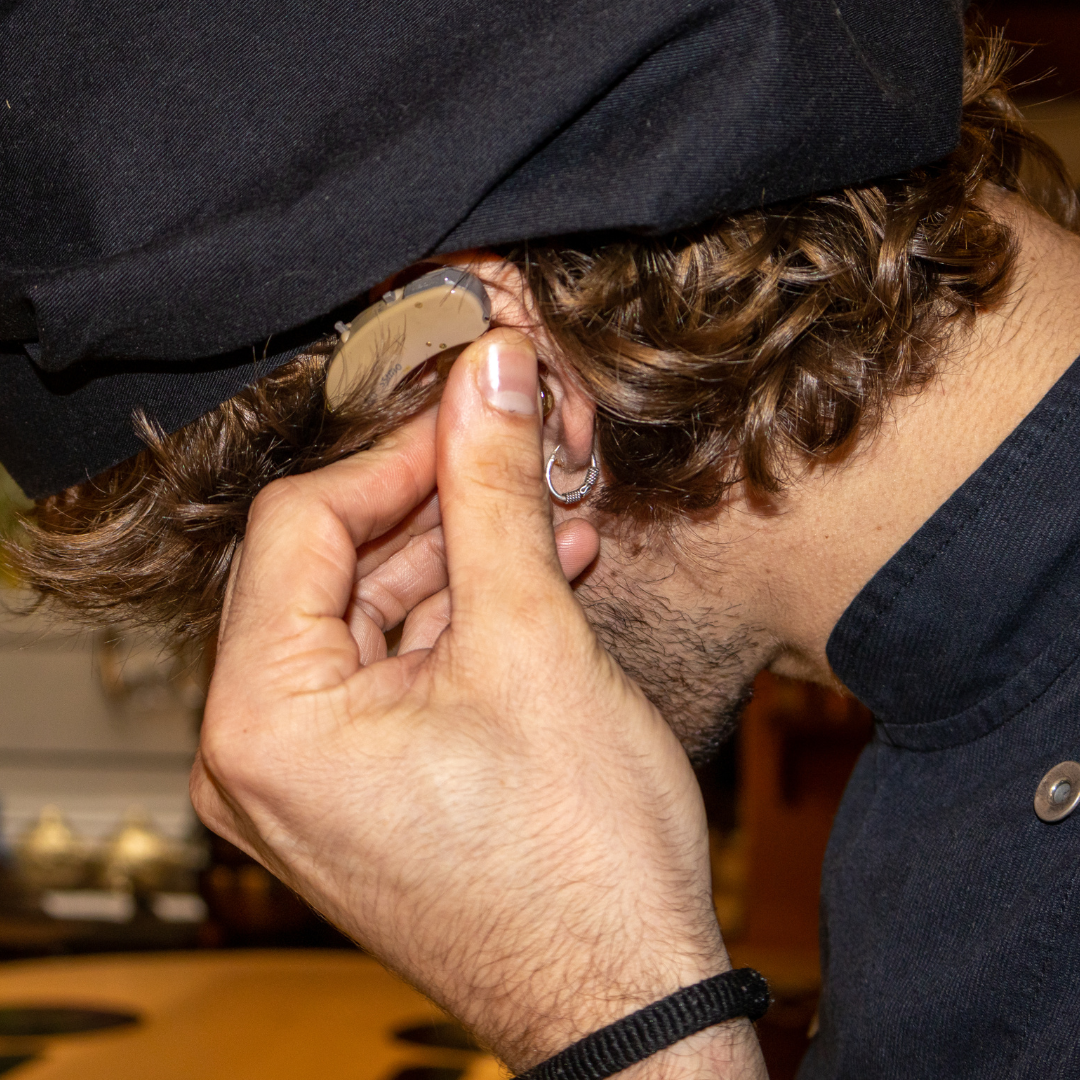
Maintaining dinner dialogue proves demanding when chaotic ambient noise strains your concentration and hearing. We perform comprehensive diagnostic assessments to evaluate hearing in quiet rooms and challenging acoustic spaces to identify functional deficits. After diagnosing the source of your difficult hearing, we design targeted interventions tailored to your listening needs.
Why Everyday Hearing Fails in Busy, Noisy Restaurants
Calm domestic settings establish a positive signal-to-noise ratio, allowing target speech to stand out clearly from faint background noises. Dining venues establish an entirely contrary auditory challenge. Cross-talk, ambient music, dishware noise, and harsh acoustic reverberation interfere with speech clarity, forcing your brain to labor to extract the target voice.
These communication barriers frequently indicate high-frequency hearing loss, central auditory-processing disorders, or age-related sensorineural changes. Attention, fatigue, dim lighting, and distance from the speaker may make it worse. It is common to display normal baseline audibility on conventional hearing tests while failing comprehensive speech-in-noise testing. Difficulty in restaurants deserves evaluation even when everyday hearing seems normal.
Diagnosing High-Frequency Hearing Loss and Clarity Issues
The diagnostic workup opens with an extensive intake examining difficult listening environments, past noise trauma, tinnitus presence, family history, and medical history.
Diagnostic pure-tone audiometry establishes the softest auditory thresholds you can perceive across standardized frequencies via air and bone conduction pathways. In high-frequency hearing loss, the audiogram reveals a sloping configuration where hearing acuity drops progressively as pitch frequencies increase. Further clinical diagnostics feature tympanometry to evaluate eardrum and middle-ear mechanics as well as word-recognition testing for speech comprehension.
Because testing in a silent booth does not mirror real-life restaurant environments, speech-in-noise testing supplies vital diagnostic clarity. This procedure gauges speech-discrimination accuracy while competing multi-source noise becomes incrementally louder. Interpreted together, these clinical scores demonstrate whether listening struggles originate from loss of audibility, speech clarity deficits, auditory processing delays, or combined elements.
Auditory Processing Disorders: Impact on Adult Communication
A diagnosed auditory processing disorder affects how the brain’s auditory cortex analyzes, organizes, and interprets sound. While peripheral ears may register soft tones normally, the auditory cortex struggles to filter competing noise, resolve phonetic contrasts, or keep pace with rapid conversation. We first evaluate peripheral hearing and then determine whether an individualized auditory-processing test battery or referrals to other professionals are appropriate.
Behavioral Strategies for Hearing Clearly in Loud Venues
Minor environmental adjustments can boost speech acoustic signals and supply critical visual lip-reading cues. When planning to dine out, select restaurants with calmer atmospheres or arrange reservations during off-peak hours. Restaurants featuring plush booths, wall acoustic panels, heavy drapery, carpeting, and sound-dampening materials provide superior listening compared to open rooms with reflective surfaces.
Practical seating strategies in the dining room:
- Ask for seating positioned far away from open kitchens, noisy bar areas, ceiling speakers, and large parties.
- Situate yourself with a structural wall behind you to minimize distracting ambient noise from behind.
- Ensure you sit directly across from speaking partners in an area with sufficient illumination for visual lip-reading.
- Reduce physical spacing between yourself and companions to maximize direct speech perception.
- Turn your better-hearing ear toward the specific speaker you want to hear most clearly.
- Request that companions rephrase misunderstandings using different words rather than repeating the same sentence.
- Confirm important details rather than pretending to understand.
- Excuse yourself for a momentary quiet pause when listening exhaustion starts to mount.
- Invite companions to focus on clear articulation and a measured, comfortable cadence.
- Yelling distorts natural speech formants and rarely makes spoken words easier to decipher.
Modern Audiological Tools for Managing Background Noise
Selecting the ideal assistive technology depends upon underlying diagnosis, specific acoustic challenges, and verified hearing loss. Modern clinical hearing aids integrate directional microphone polar patterns, automated digital noise suppression, and personalized restaurant memory settings to highlight frontal speech and reduce background competition. However, users must maintain realistic expectations, as no clinical technology can eliminate every competing background speaker entirely.
Remote wireless microphones offer an exceptional boost to the signal-to-noise ratio in challenging venues. The remote unit is attached to the speaker’s clothing or placed nearby, transmitting that voice straight into compatible hearing aids or an audio receiver. This reduces the effects of distance and surrounding noise.
Additional effective assistive technologies include:
- Portable table microphones for managing multi-speaker dinner conversations
- Built-in telecoils linking directly with induction hearing-loop systems in public venues
- Real-time smartphone speech-to-text transcription and live-captioning apps
- Over-the-counter hearables equipped with directional speech-enhancement algorithms
- Decibel-monitoring apps and crowd-sourced dining platforms that track restaurant noise
We will help compare available technology, verify device compatibility, and instruct you on utilizing your selected hearing equipment.
How Can a Doctor Help with Hearing in Loud Places?
Clinical hearing evaluations progress the diagnostic process past the typical assertion that hearing is adequate in quiet. Our clinicians review the specific environments, vocal pitches, and decibel levels that trigger breakdowns to design a personalized test protocol. The assessment may include pure-tone thresholds, middle-ear testing, word recognition, and speech-in-noise measures. Auditory-processing testing may be considered when the history and initial results support it.
Hearing changes that present abruptly, affect only one side, or progress rapidly necessitate consultation with an ear, nose, and throat physician. Tailored audiological treatment identifies the exact origin of listening breakdown rather than assuming environmental dining noise is the sole culprit.
Schedule a Diagnostic Hearing Evaluation Right Away
If struggling through dinner conversation leaves you mentally exhausted, detached, or constantly guessing, schedule a complete hearing evaluation with our clinic. We can evaluate targeted solutions to optimize your hearing in noisy environments using prescription hearing aids, assistive listening technology, or communication strategies tailored to you.
Reach out to our audiology clinic today to schedule an evaluation and begin enjoying clear, effortless conversations.
