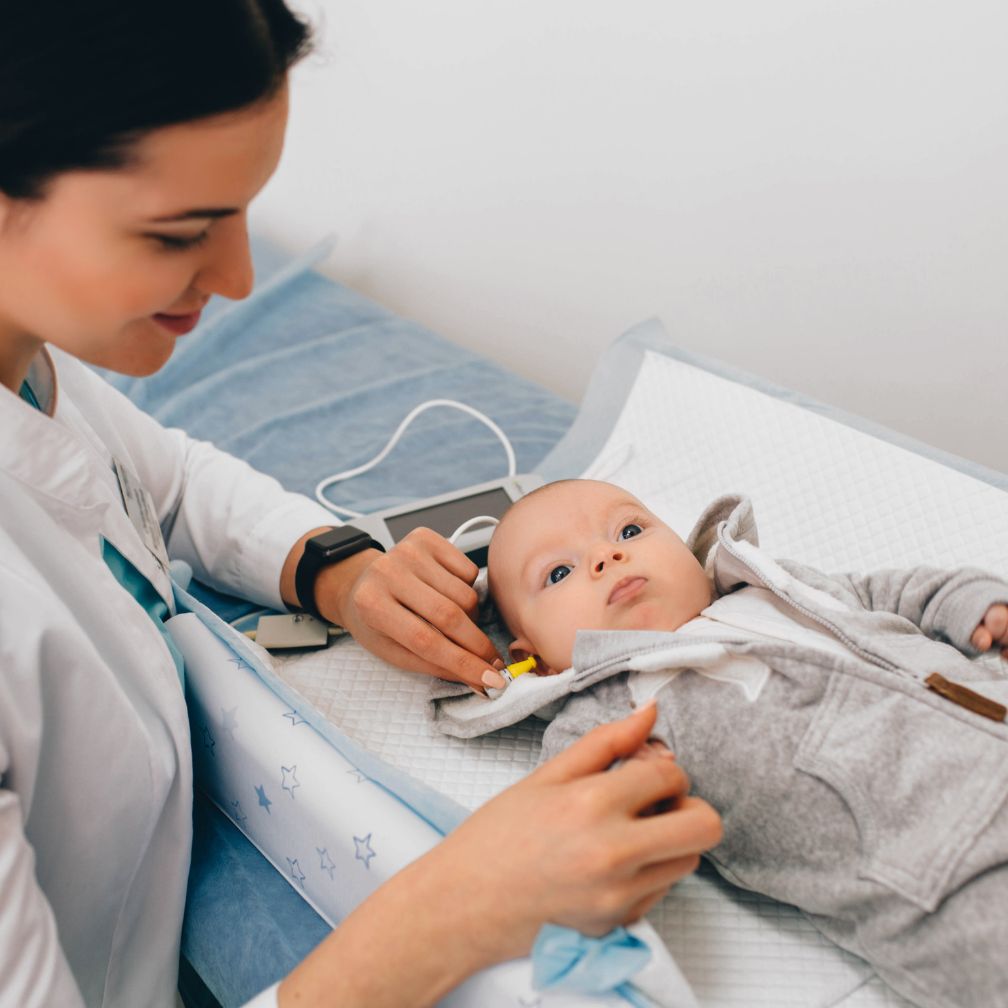
For guardians of newborns, finding out that a newborn has a hearing challenge rapidly creates overwhelming emotional strain. Yet the positive perspective remains that via early care and screening, infants experiencing hearing loss can genuinely thrive over time. Truly, these infants routinely acquire core language skills, social capabilities, and firm bonds with people in their lives, securing a prosperous life!
Two of the most effective tools for assisting infants with hearing loss include custom hearing aids and cochlear implants. Within this guide, we review their operational methods to assist you in choosing the most effective pathway for your infant.
Analyzing Infant Auditory Deficits
Congenital hearing impairment in infants can develop due to specific root causes, such as:
- Specific hereditary genetic markers (even when devoid of any known parental history)
- Congenital pathogen exposures including cytomegalovirus (CMV) and rubella agents
- Physical birth-related trauma, featuring neonate oxygen loss or premature delivery
- Specific intensive care medications applied in specialized newborn facilities
Which step demands immediate priority? Early medical diagnosis. This necessity explains why babies across the United States undergo auditory checks before departing the nursery. Qualified pediatric hearing professionals follow the established “1-3-6” care guideline:
- Primary hearing check administered within 30 days of birth
- Comprehensive diagnosis completed inside 90 days of life
- Early care (incorporating amplification systems or active therapy) established prior to 6 months of life
Meeting these clinical targets gives infants an unparalleled opportunity for normal speech, expressive language, and cognitive progression. Whenever you seek direction on these auditory tests, your child’s pediatrician will gladly advise you!
Wearable Hearing Aids in Infant Care
For young children demonstrating mild to severe hearing challenges, fitted hearing aids regularly function as the frontline remedy. These small, wearable devices boost incoming sound waves, enabling infants to perceive speech and ambient sounds with greater clarity.
Tailored infant hearing instruments serve as:
- Proven safe for young infants as young as a few weeks old
- Crafted featuring soft, comfortable ear molds that change as the baby grows
- Assembled with tamper-proof battery doors and child-focused protective mechanisms
- Precisely tuned by a pediatric audiology specialist to target your infant’s unique hearing profile
Throughout early childhood growth, these devices demand ongoing professional tuning to ensure snug placement and precise amplification.
Understanding Cochlear Implantation for Babies
Should an infant present with severe to profound sensorineural hearing loss and demonstrates limited success with standard amplification, medical teams often recommend a cochlear implant. Unlike standard acoustic hearing devices, cochlear implant systems:
- Need a targeted surgical procedure for final insertion executed by a pediatric specialist
- Safely route around damaged structures within the cochlear system
- Convert surrounding audio into precise electrical signals that stimulate hearing nerve pathways directly
Modern cochlear implants serve as:
- Formally FDA-sanctioned for application in babies as young as 9 to 12 months
- Highly successful when paired with early speech intervention and enthusiastic family care
- Cleared only after a complete diagnostic battery performed by an audiologist alongside an ENT physician
That multi-step journey involves temporal bone imaging, objective hearing assessments, and detailed consultations regarding anticipated long-term progress.
Comparing Hearing Aids and Cochlear Implants: Key Differences
- Mild to severe hearing loss targets Hearing Aids; Severe to profound hearing loss requires Cochlear Implants
- Non-Invasive: Hearing Aids; Invasive surgical placement: Cochlear Implants
- Acoustic sound amplification: Hearing Aids; Digital electrical impulse transformation: Cochlear Implants
- Starts at Infancy: Hearing Aids; Starts at 9-12 Months: Cochlear Implants
Concluding Guidance on Pediatric Hearing Technology
In the event your infant receives a hearing loss diagnosis, you possess multiple viable options alongside extensive professional backing. Thanks to collaboration with dedicated pediatric audiologists, a vast majority of children attain speech and language milestones fully matching their playmates.
Whether your youngster qualifies for external hearing aids or surgical cochlear implants, early intervention unlocks lifelong developmental success.
Have questions about your baby’s hearing health? Reach out to our specialists today for a complete diagnostic review and tailor-made care roadmap.
